
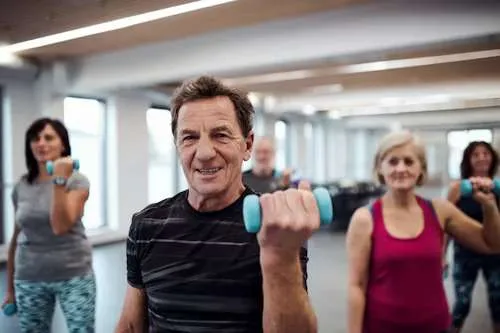
There’s a version of getting older in golf that most people just accept: shorter drives, a sore back after every round, the gradual creep of pain in the hips or knees, and eventually, a quiet reduction in how often you’re able to play. It feels inevitable. But here’s what most golfers over 60 don’t realize — it doesn’t have to be.
The physical changes that come with age are real. Muscles get smaller. Joints stiffen. Recovery takes longer. But the vast majority of those changes are not fixed — they respond directly to the right kind of training. Weight training for golfers over 60 isn’t about chasing your 30-year-old body. It’s about getting golf fit by building the specific strength, stability, and mobility that let you play more golf, play better golf, and do it without spending the next two days recovering from a single round.
This guide covers exactly how to do that. We’ll explain what’s happening in your body as you age, why strength training is the single most important physical investment a senior golfer can make, which exercises deliver the best results, and how to train safely no matter where you’re starting from.
What Actually Happens to the Body After 60 (And Why It Matters for Golf)
Understanding what you’re working against is the first step to working through it effectively.
Sarcopenia: The Muscle Loss Nobody Talks About
Starting in your 30s and accelerating significantly after 60, your body begins losing skeletal muscle mass at a measurable rate. This process — called sarcopenia — affects not just how you look or how much you can lift, but your balance, your coordination, your swing speed, and your ability to recover between rounds and between holes. The Cleveland Clinic defines sarcopenia as the progressive and generalized loss of skeletal muscle mass, strength, and function that occurs with aging — and estimates that it affects somewhere between 5 and 13 percent of adults over 60, rising sharply with each decade after that.
For golfers, sarcopenia shows up in very specific ways: reduced clubhead speed as the fast-twitch fibers responsible for explosive power are the first to go, less stability through the swing as postural muscles weaken, and a longer recovery window that makes playing multiple days in a row increasingly difficult.
The critical thing to understand here is that sarcopenia is not inevitable. It is heavily influenced by physical activity — and specifically by resistance training. Muscle responds to load at any age. The biology of muscle adaptation doesn’t shut off at 60. It slows down, but it doesn’t stop.
Joint Changes and Injury Risk
After 60, tendons become less elastic, cartilage thins, and joints require more deliberate warm-up before they’re ready to handle load. Golf, with its repetitive high-speed rotational demands, places significant stress on joints that are already dealing with these changes. Research published in PMC and reviewed across multiple epidemiological studies found that the lower back is the most commonly injured site in golf, accounting for 25% of all golf-related injuries — and that injury rates increase significantly with age. When hip mobility and trunk muscle activation are insufficient, the lower back absorbs forces it was never designed to handle alone.
This is exactly what weight training for golfers over 60 is designed to prevent. A well-built senior golf fitness program strengthens the muscles that protect your joints, improves the mobility that reduces compensatory strain, and builds the stability that keeps your spine safe under the rotational loads of the golf swing.
Reduced Bone Density
Bone density peaks in your late 20s and declines gradually from there — a process that accelerates after menopause in women and continues steadily in men through their 60s and 70s. Lower bone density increases fracture risk and contributes to the joint pain that many older golfers attribute simply to “getting old.” The good news: resistance training is one of the most effective interventions available for slowing bone density loss. A systematic review published in the Journal of Sport Rehabilitation found that strength training performed 2 to 3 times per week produced significant increases in lumbar spine bone mineral density in older adults — which is exactly the area of the spine that takes the most stress during a golf swing.
Why Strength Training Is the Best Thing a Golfer Over 60 Can Do
The instinct for many older golfers when something hurts is to do less. Rest it, protect it, reduce activity. Sometimes that’s the right short-term call — but as a long-term strategy, it accelerates exactly the physical decline you’re trying to avoid.
Senior golf fitness built on resistance training does the opposite. It addresses the root causes of pain and physical limitation rather than working around them. Here’s what a well-designed weight training program actually delivers for a golfer over 60:
More clubhead speed. The fast-twitch muscle fibers responsible for explosive rotational power can be trained and partially recovered through resistance and power-based exercise. Golfers who train consistently don’t have to accept a 20-yard distance loss as a fact of aging.
Better balance and stability. Single-leg exercises, hip strengthening, and core stability training directly improve the postural control that keeps your swing on plane and your body safe walking a hilly course for four hours.
Less pain between rounds. Stronger glutes, hamstrings, and hip rotators mean less compensatory load on your lower back. A stronger upper back means better posture and less shoulder impingement. The relationship between strength and pain reduction in older golfers is consistent and well-documented.
Longer playing years. This is the one that matters most. The golfers we’ve worked with at P4S Golf who commit to a structured training program in their 60s don’t just play better — they play longer. They’re on the course in their 70s and 80s with less pain and more consistency than peers who didn’t train.
How to Train Safely: The Principles That Matter Most for Golfers Over 60
Training at 62 is not the same as training at 32. That’s not a limitation — it’s just a different set of rules. Here are the principles that govern safe, effective weight training for golfers over 60:
Start With an Assessment, Not a Program
The single most important thing a senior golfer can do before beginning any training program is to get properly assessed. Your injury history, joint health, current mobility, and existing strength levels all determine what’s appropriate — and what could cause harm. Training without this information is the most common reason older athletes get hurt in the gym.
Our golf performance assessment is built for exactly this situation. It identifies your physical starting point with precision so your program is built around your actual body — not a generic template designed for a 40-year-old with no history of back pain.
Prioritize Mobility Before Load
For golfers over 60, mobility work isn’t optional warm-up — it’s half the program. Restricted hip mobility, a stiff thoracic spine, and tight hip flexors are the most common physical causes of back pain, reduced swing arc, and poor sequencing in older golfers. Before adding load, spend real time restoring range of motion in these areas. The payoff in both swing quality and pain reduction is immediate.
Train Movement Patterns, Not Muscles
The best exercises for senior golfers are the ones that train the movement patterns the golf swing actually uses: the hip hinge, rotation, single-leg stability, and horizontal push and pull. These compound patterns build functional strength that transfers directly to the course — not just strength that shows up on a leg press machine.
Progress Conservatively and Consistently
Older tissue recovers more slowly than younger tissue. That’s not a reason to avoid training hard — it’s a reason to progress methodically. Start with moderate loads and higher rep ranges (10–15 reps), focus on technique before adding weight, and allow adequate recovery between sessions. Consistent moderate training over months produces far better outcomes than aggressive training that leads to injury after three weeks.
Two to Three Days Per Week Is Enough
You don’t need to be in the gym every day. Research consistently shows that 2 to 3 sessions per week is the optimal training frequency for older adults looking to build muscle and improve physical function. More than that, especially without adequate recovery, often does more harm than good for golfers over 60.
The Best Weight Training Exercises for Golfers Over 60
Every exercise below was selected because it directly addresses one or more of the physical qualities that decline with age and that matter most in golf: hip strength, rotational power, core stability, upper back health, and balance. Each comes with specific instructions so you can perform it safely.
Hip Hinge: Romanian Deadlift (RDL)
If there is one exercise every golfer over 60 should do, it’s the RDL. It builds the hamstring and glute strength that drives the golf swing and protects the lower back — and it does so through the hip hinge pattern that is directly replicated at address and impact.
How to perform it safely: Start with light dumbbells or even bodyweight. Stand with feet hip-width apart, slight bend in the knees. Push your hips back — not down — while keeping your spine long and neutral. Lower until you feel a stretch in your hamstrings, then drive through your heels to return. The back does not round. The movement comes entirely from the hips. Begin with 2–3 sets of 10–12 reps, focusing entirely on feeling the right muscles work before adding any weight.
Single-Leg Balance and Strength: Step-Up
The golf swing loads one leg at a time. Your lead leg must be strong enough and stable enough to receive and decelerate the force of the entire downswing. For golfers over 60, single-leg training also directly improves the balance and proprioception (the body’s sense of its own position) that reduces fall risk — a major health concern as we age.
How to perform it safely: Use a low step or box (6–8 inches to start). Place one foot on the step and drive through that heel to stand fully. Control the descent. Hold a wall or railing for balance until you’re confident without it. 2–3 sets of 10 reps per leg.
Core Stability: Dead Bug
The dead bug is one of the most valuable exercises in senior golf fitness because it builds deep core stability without placing any compressive load on the spine — which makes it safe for golfers with existing back issues while still producing meaningful results.
How to perform it safely: Lie on your back with arms extended toward the ceiling and knees bent at 90 degrees, shins parallel to the floor. Press your lower back firmly into the floor — this contact must be maintained throughout. Slowly lower your right arm and left leg toward the floor simultaneously, return, and switch sides. If your lower back lifts off the floor at any point, reduce your range of motion. 2–3 sets of 8–10 reps per side.
Anti-Rotation Core: Pallof Press
Golf requires your core to resist rotational forces just as much as it requires producing them. The Pallof press builds exactly this quality — and it does so with zero spinal loading, making it ideal for older golfers with a history of back pain.
How to perform it safely: Anchor a resistance band or set a cable machine at chest height. Stand perpendicular to the anchor, holding the band or handle with both hands at your sternum. Press straight out in front of you and hold for 2–3 seconds. Do not let the band pull you into rotation. Return slowly. 2–3 sets of 10 reps per side.
Upper Back: Seated Cable Row or Resistance Band Row
Rounded shoulders and a weak upper back are among the most common postural problems in golfers over 60 — and they directly contribute to limited shoulder turn, impingement issues, and the hunched posture that affects swing plane. Rowing movements correct this imbalance and are safe for almost every shoulder condition.
How to perform it safely: Sit at a cable machine with a neutral grip handle, or anchor a resistance band at waist height and sit or stand facing it. Pull the handle toward your lower chest, squeezing your shoulder blades together and keeping your elbows close to your body. Do not shrug or use momentum. 3 sets of 12–15 reps. This is one of the safest, highest-return exercises in any senior golf fitness program.
Rotational Power: Band or Cable Rotation
Rotational power is the most golf-specific quality you can train — and it’s the most rapidly lost with age if it isn’t trained. This exercise rebuilds it through the same movement pattern used in the swing.
How to perform it safely: Anchor a resistance band or set a cable at waist height. Stand perpendicular to the anchor with feet shoulder-width apart. Hold the band with both hands and rotate away from the anchor, initiating the movement from your hips. Control the return. The key for golfers over 60 is to focus on hip drive — let the hips lead and the upper body follow, exactly as in a golf swing. Start with a light band and focus on quality of movement. 3 sets of 10 reps per side.
Shoulder Health: Face Pull
The face pull is the one exercise most older golfers are missing — and it’s the one that most directly protects their shoulders. It strengthens the rear deltoids and external rotators, corrects the forward-shoulder posture that comes from years of sitting and swinging, and reduces the impingement risk that makes overhead movement painful.
How to perform it safely: Set a cable or band at face height. Pull the handles toward your face while flaring your elbows wide and rotating your forearms up at the end of the movement — as if you’re showing your biceps. Control the return. 3 sets of 15 reps. This is appropriate for almost every shoulder condition and should be in every senior golfer’s program without exception.
A Sample Weekly Senior Golf Fitness Routine
Here’s how a complete 3-day-per-week program for a golfer over 60 might look. Each session is under 45 minutes, covers all the essential physical qualities, and includes appropriate warm-up time:
Day 1 — Hip Strength + Core Stability
- Foam rolling: glutes, hamstrings, thoracic spine (8 min)
- Hip 90/90 mobility drill: 2 × 60 seconds per side
- Bodyweight glute bridge: 2 × 15 (activation)
- Romanian Deadlift: 3 × 10
- Step-Ups: 3 × 10 per side
- Dead Bug: 3 × 8 per side
- Hip flexor stretch: 60 seconds per side
Day 2 — Rotational Power + Balance
- Thoracic foam roller extension: 90 seconds
- Band pull-aparts: 2 × 20
- Band or Cable Rotation: 3 × 10 per side
- Pallof Press: 3 × 10 per side
- Single-leg balance hold (eyes open, then closed): 3 × 20 seconds per side
- Side-lying clamshell: 2 × 15 per side
- Upper back foam rolling
Day 3 — Upper Body + Shoulder Health
- Shoulder mobility warm-up: 10 min
- Seated Cable or Band Row: 3 × 12
- Face Pull: 3 × 15
- Single-arm dumbbell press (light): 3 × 10 per side
- Band pull-aparts: 2 × 20
- Step-Ups: 2 × 10 per side (maintenance)
- Dead Bug: 2 × 8 per side
Rest at least one day between sessions. On days you play golf, treat the round itself as your primary physical activity and allow full recovery afterward before returning to the gym.
What to Avoid: Common Mistakes in Senior Golf Fitness
Training at 60-plus comes with specific pitfalls that can derail progress or cause injury if you’re not watching for them:
Skipping the warm-up. For golfers over 60, a proper warm-up is not optional. Cold muscles and stiff joints respond very differently to load than warmed-up tissue. Spend at least 8–10 minutes mobilizing before every session and before every round.
Using too much weight too soon. Ego is one of the most common causes of training injury in older athletes. Start lighter than you think you need to, nail the movement pattern, and add load gradually over weeks — not days.
Neglecting single-leg work. Most older golfers prefer bilateral (two-legged) exercises because they feel safer and more stable. But single-leg training is precisely what builds the balance and unilateral strength that protects you on the course and in everyday life.
Training through joint pain. Muscle soreness after a session is normal and expected. Sharp joint pain, pain that persists for more than 48 hours, or pain that worsens during an exercise is not normal — it’s a signal to stop and get assessed. Our golf physical therapy team can help identify what’s causing the pain and build a path forward that doesn’t require stopping training entirely.
Going it alone without guidance. The stakes of getting training wrong are higher at 60 than at 30. An injury that a younger golfer recovers from in two weeks might sideline an older golfer for months. Working with a professional who understands both the aging body and golf biomechanics is not a luxury — it’s the most efficient and safest investment you can make.
Home Training for Senior Golfers
One of the best things about senior golf fitness is how effectively it can be done at home. For golfers who don’t want to join a gym, deal with peak-hour crowds, or make a commute part of their routine, a well-designed home program using resistance bands, a pair of dumbbells, and a foam roller covers nearly everything in the sample plan above.
Resistance bands in particular are ideal for golfers over 60: they’re joint-friendly (the resistance increases as the band stretches, which mirrors the natural strength curve of most movements), highly versatile, inexpensive, and easy to store. A set of bands at three different tensions combined with a pair of medium-weight dumbbells is enough to perform every exercise in this guide.
For a full equipment guide and home-specific program options, visit Golf Specific Workouts for Your Home Gym.
How P4S Golf Helps Golfers Over 60 Train Smarter
At P4S Golf, we work with senior golfers every week — people who have been told their playing days are numbered, who are managing old injuries, who have tried generic fitness programs and found them either too aggressive or too disconnected from what golf actually requires.
Our approach starts with a thorough golf performance assessment that identifies your exact physical starting point: where you’re restricted, where you’re weak, what’s driving any pain you’re experiencing, and what your body is genuinely capable of right now. From there, we build a program that’s specific to you — not a modified version of someone else’s program, but one designed from the ground up for your body, your history, and your goals.
If you’re in the Raleigh area, our local golf fitness and physical therapy services give you access to in-person assessment and hands-on coaching with specialists who understand both movement science and the demands of golf at every age.
Not local? Our remote adult program delivers the same expertise wherever you are — through detailed online programming, video coaching, and regular check-ins that keep you progressing safely and with full professional support.
When you’re ready to stop accepting physical decline as inevitable and start building the strength that keeps you on the course, book your first session with our team here.
The Bottom Line
The golfers who play the best golf in their 60s, 70s, and beyond aren’t the ones who stopped pushing themselves. They’re the ones who learned how to push themselves the right way.
Weight training for golfers over 60 is not about becoming an athlete. It’s about maintaining the physical capacity to do something you love — to make a full shoulder turn, to drive through your hips at impact, to walk 18 holes without your back locking up on the 14th, and to wake up the next morning ready to do it again.
Your body will respond to the right training at any age. The only question is whether you give it the chance.

